Health Services
What are the differences between the levels of a practitioner from EMR to Advanced Care Paramedic?

How do you choose the right level of practitioner for your project or event?
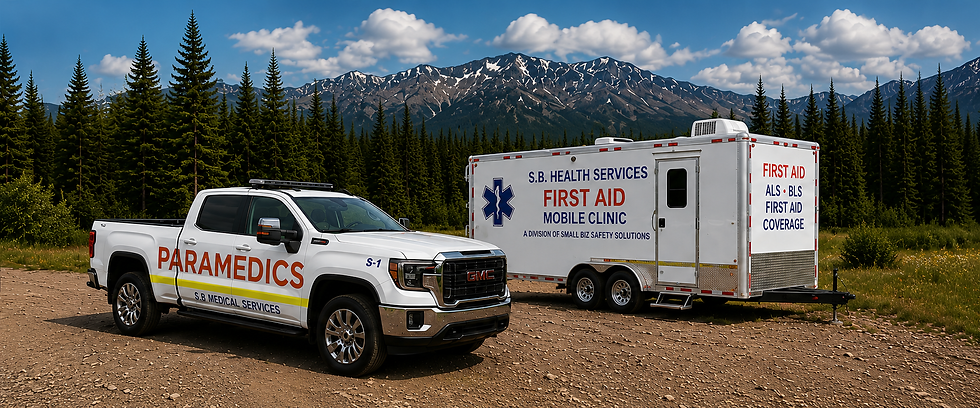
Our paramedics provide basic and advanced emergency medical care, along with primary healthcare support, in challenging and remote environments across Canada. Medical services can be adapted to the needs of each operation. Coverage may include a paramedic stationed at the work site, a mobile treatment center, a staffed occupational health clinic, or a designated first aid room or trailer. Whether supporting a small crew, a large industrial project, or a public event, our personnel arrive prepared with the appropriate equipment and medications, to perform emergency-response on your site.
How Much Medical Coverage Does Your Site Require?
The number and level of medical personnel required will depend on the occupational health and safety legislation that applies to the workplace. Canada has federal, provincial, and territorial occupational health and safety jurisdictions, and first aid requirements vary between them.
In Alberta for example, workplace legislation regarding first aid requirements are determined using three primary factors:
-
The hazard level of the work
-
The number of workers at the work site
-
The travel time to an appropriate healthcare facility
Work is classified as low, medium, or high hazard. As the number of workers, level of risk, and distance from healthcare services increases, additional first aid personnel, supplies, equipment, or a dedicated first aid room will be required. Our team can help review your work environment, location, staffing levels, and anticipated hazards to identify an appropriate level of medical coverage. Sometimes doing the minimum isn't enough. Help ensure your workers have timely access to qualified medical care while supporting compliance with the legislation applicable to your operation. A light comparison of the skills between providers is shown below.
Meeting the Requirement—and Planning Beyond It
Under Alberta’s Occupational Health and Safety requirements, a high-hazard, isolated work site with 100 to 199 workers per shift requires a minimum of four Intermediate First Aiders, one Advanced First Aider, and a designated first aid room. An isolated work site is one located more than 40 minutes from a healthcare facility. Under the Alberta OHS Code, the definition of an Advanced First Aider includes a person holding an approved advanced first aid certificate. Although these qualifications may satisfy the workplace requirement, the training, equipment, and available treatment options can differ considerably from company to company. Legislated requirements establish the minimum level of first aid coverage. Employers should also consider the actual hazards of the work, the likelihood of a serious medical emergency, access and road conditions, communication limitations, weather, and the availability of the local ambulance service. The higher the provider on site the closer you are to having the emergency room right at your door.
A site may be calculated as being 40 minutes from a healthcare facility, but that does not necessarily mean an ambulance will arrive within 40 minutes. During periods of high call volume, there may be a "Code Red", meaning ambulances may be responding from a neighboring service area. Alberta EMS reports have recognized that communities can experience periods when no ambulance is immediately available to respond and it happens quite often. It's a reality we see almost daily.
Our personnel have responded to 911 emergencies more than an hour away because they were the closest available ambulance. Experiences like these demonstrate why emergency medical planning should not be based solely on the distance to the nearest hospital or the minimum number of first aiders required by legislation. You can imagine the outcome of a heart attack, or serious traumatic injury in this situation if the ambulance is an hour away.
Having a paramedic and properly equipped medical unit on site will provide earlier assessment, treatment, stabilization- which will decrease in the extent of damage done, (decreasing recovery time) provide pain management, cardiac monitoring, medication administration, and coordination with responding emergency services or STARS. At times, the worker may be treated on site and be released to return to work. This can save on lost time. The appropriate level of coverage should be determined through a site-specific risk assessment. Meeting the minimum requirement is important. Ensuring that workers have timely access to the level of care appropriate for the hazards and location of the operation is responsible emergency planning.

EMR and Paramedic SKills By level.
Skills and Medications vary by Province.
Emergency Medical Responder
Emergency Medical Responders provide essential first-response and basic life-support care for patients experiencing injuries, illnesses, and medical emergencies. EMRs are trained to quickly assess a patient’s condition, provide immediate treatment, and support the patient until additional medical resources arrive or transportation to a healthcare facility can be arranged.
Their capabilities may include cardiopulmonary resuscitation, the use of an automated external defibrillator, oxygen administration, bleeding control, spinal motion restriction, basic airway management, and treatment for shock and other urgent conditions.
Primary Care Paramedic
Primary Care Paramedics provide essential pre-hospital emergency care and basic life-support services for patients experiencing injuries, illnesses, and medical emergencies.
PCPs are trained to assess patients, recognize potentially serious conditions, begin treatment, and provide continued care during transportation to a medical facility.
Their capabilities may include establishing intravenous access, administering intravenous fluids, monitoring vital signs, performing cardiac monitoring, managing airways, providing oxygen therapy, and using supraglottic airway devices when required.
PCPs may administer a range of medications according to approved clinical protocols. These may include medications for nausea and allergic reactions, oral glucose for low blood sugar, non-narcotic pain relief, anti-inflammatory medications, naloxone for suspected opioid poisoning, acetylsalicylic acid for certain cardiac emergencies, nitroglycerin for eligible patients experiencing chest discomfort, and normal saline for fluid replacement.
Pain-management options may include medications such as ibuprofen, nitrous oxide and oxygen—commonly known as Entonox—or methoxyflurane, commonly known as Penthrox, when clinically appropriate and authorized.
Primary Care Paramedics play an important role in identifying time-sensitive medical conditions, calling for Advanced Life Support when its available, beginning early treatment, monitoring changes in a patient’s condition, and arranging timely transportation to an appropriate medical facility. Their training allows them to manage a wide variety of medical and traumatic emergencies while coordinating with Advanced Care Paramedics, physicians, nurses, and other healthcare professionals when additional care is required.
Services and procedures are provided in accordance to legislation, medical direction, clinical practice guidelines, and the individual paramedic’s authorized scope of practice.
Advanced Care Paramedic
Advanced Care Paramedics provide advanced life-support care for patients experiencing serious or life-threatening medical emergencies. ACPs complete additional education and clinical training that allows them to perform advanced assessments, administer a broad range of medications, and carry out specialized medical procedures within their authorized scope of practice.
Their capabilities may include advanced airway management, cardiac monitoring, 12-lead ECG interpretation, intravenous and intraosseous access, and the administration of medications used to manage cardiac emergencies, severe pain, nausea, seizures, respiratory distress, and other urgent medical conditions.
ACPs can provide advanced pain management using medications such as morphine, fentanyl, or ketamine when clinically appropriate. They may also perform advanced airway procedures, including endotracheal intubation and, in rare life-threatening circumstances, emergency surgical airway procedures such as cricothyrotomy.
Additional skills include advanced wound care, suturing where authorized, newborn and post-delivery care, and the administration of medications such as oxytocin.
Point-of-care diagnostic equipment, including devices such as the i-STAT system, may also be used to obtain timely clinical information that supports treatment and transport decisions. Ventilators if a patient is intubated. They can also perform needle decompression of the chest
with tension pneumothorax cases.
During cardiac arrest, ACPs can provide advanced resuscitation interventions on site. This means in a cardiac arrest the patient wont be loaded and rushed to the hospital, unless certain situations warrant it. Early access to this level of care can help stabilize patients, support timely clinical decisions, and improve continuity of care from the scene to the receiving medical facility.
Services and procedures are provided in accordance to legislation, medical direction, clinical practice guidelines, and the individual paramedic’s authorized scope of practice.